Vintage Tractor Restoration

There’s something deeply satisfying about a vintage tractor running the way it did fifty years ago. Or a classic piece of farm equipment—a hay baler, a grain elevator, an old pull-behind plow—restored to working condition rather than left to rust in a fence row. For a lot of people, this isn’t just about nostalgia. It’s about preserving equipment that was built to last, honoring the craftsmanship of an earlier era, and in many cases, putting something genuinely useful back into service.

But restoration is not a simple process. Old iron comes with old problems: corrosion that runs deeper than it looks, parts that haven’t been manufactured in decades, metal fatigue that isn’t visible to the naked eye, and surface damage that tells the story of every hard season the machine endured. Bringing that equipment back properly requires more than a wire brush and a coat of paint. It requires a fabrication shop with the right combination of skills, equipment, and patience to work through the challenges that vintage restoration almost always presents.

At Double R Manufacturing and Double R Machining, restoration work draws on nearly every service we offer—often within a single project. Here’s a look at what that actually involves.


The Assessment: Starting With What You Have

Every restoration begins the same way: understanding the true condition of the piece. Surface rust is one thing. But decades-old farm equipment has often experienced stress fractures in welds, thinning metal from corrosion-from-the-inside-out, bent or twisted structural members, and fasteners that are essentially fused in place.

Before any work begins, it’s worth doing a thorough mechanical and structural assessment. What’s solid? What’s compromised? What’s missing entirely? The answers to those questions shape everything that follows—the order of operations, which services are needed, and whether certain components need to be fabricated from scratch because they simply can’t be sourced anywhere else.

That last point comes up more than people expect. Parts for equipment manufactured in the 1940s, 1950s, and 1960s often don’t exist in the aftermarket anymore. Reproduction parts for common vintage tractors are available, but anything more specialized—a custom bracket, a wear plate, a specialized linkage component—may need to be fabricated to original specifications or reverse-engineered from what’s left of the worn-out original. This is where CNC machining and custom fabrication become central to the restoration process, not just finishing touches.


Sandblasting: Getting Down to the Truth

Before any welding, fabrication, or finishing can happen, the metal needs to be clean—genuinely clean, not just surface-clean. This is where sandblasting earns its place as one of the most important steps in any serious restoration.

Decades of paint, rust, grease, and surface oxidation can hide the actual condition of the metal underneath. Sandblasting strips all of it away, revealing hairline cracks, pitted surfaces, thinned sections, and areas where rust has eaten further than expected. On vintage equipment, this step regularly changes the scope of the project—in ways that ultimately save money and produce a better result.

Sandblasting also creates the surface profile that makes subsequent finishing work last. Paint, primer, and powder coating all bond more effectively to a properly blasted surface than to metal that’s been sanded or chemically stripped. For a restoration that’s meant to last another fifty years rather than just look good for a season, that bond quality matters enormously.

Different media are used for different situations. Aggressive abrasives remove heavy rust and scale quickly. Finer media are used for thinner metal or surfaces where maintaining dimensional accuracy is important. The right choice depends on the material, its condition, and what comes next in the process.


Welding: The Heart of Structural Restoration

For vintage equipment with any structural damage, welding is where the real restoration work happens. Cracked frames, broken mounting tabs, worn attachment points, split seams on implements—these are the kinds of repairs that determine whether a piece of equipment is genuinely restored or just cosmetically refreshed.

Quality welding on restoration projects requires more than technical skill. It requires understanding how the original piece was constructed, what stresses it was designed to handle, and how decades of use may have changed the properties of the surrounding metal. Welding into old, potentially brittle, or work-hardened metal demands careful preparation and the right process selection. A weld that looks good but doesn’t account for the condition of the base metal can fail under load—often at the worst possible moment.

For structural repairs on frames and load-bearing components, the goal is always a repair that’s as strong as or stronger than the original construction. For cosmetic or non-structural repairs—restoring sheet metal, replacing worn panels, fabricating missing trim or guards—the goal shifts toward matching original appearance while maintaining durability.

Custom fabrication steps in when original parts can’t be welded back together or sourced elsewhere. A mounting bracket that’s cracked beyond repair gets reverse-engineered and fabricated new. A worn wear plate gets replaced with a fresh piece cut to the original profile. A missing implement hitch gets built to spec. These aren’t workarounds—they’re how a proper restoration handles the realities of working with old equipment.


CNC Machining: Precision Where It Counts

Not every restoration need involves structural steel. Vintage tractors and farm equipment have shafts, bushings, gears, pins, and precision-fit components that may be worn, damaged, or completely unavailable as replacement parts.

This is where CNC machining fills a critical gap. When a worn shaft needs to be turned to original dimensions, when a bushing needs to be machined to fit a specific bore, or when a simple but unobtainable part needs to be replicated from a drawing or a physical sample, precision machining makes it possible. The alternative—hunting for a reproduction part that may or may not exist, or running worn components that introduce slop and accelerate further wear—rarely produces a better outcome.

For collectors and restorers working on equipment that still needs to function rather than just display, machined components often make the difference between a tractor that runs right and one that runs well enough.


Powder Coating: A Finish Built to Last

Once the structural work is done and the surfaces are prepared, the finishing stage determines how the restoration holds up over time. For vintage farm equipment that’s going back into service, or even for display pieces that will be exposed to the elements, powder coating is the most durable finish available.

Unlike liquid paint, powder coating is applied electrostatically and cured under heat, producing a finish that bonds at a molecular level with the metal surface. It’s significantly more resistant to chipping, scratching, UV fading, and moisture than conventional paint—and when applied over a properly sandblasted surface, it can realistically last decades without significant deterioration.

For restoration work, powder coating also offers something liquid paint traditionally struggles with: consistency. Color matching to original equipment colors is achievable, and the finish quality is uniform across complex shapes and hard-to-reach surfaces in ways that brush or spray application can’t always replicate.

For pieces where absolute originality is the goal—concours-level restorations for show or competition—some restorers prefer period-correct liquid paint finishes. That’s a legitimate choice. But for equipment that’s going back to work, powder coating’s durability advantage is hard to argue with.


The One-Stop Advantage in Restoration Work

What makes complex restoration projects challenging isn’t usually any single service—it’s the coordination between them. Sandblasting before welding. Welding before machining. Machining before final assembly. Powder coating last. When those steps happen in different places, with different shops, communication gaps, scheduling conflicts, and inconsistent standards add up quickly.

Handling the full sequence under one roof changes that dynamic. Assessment, sandblasting, welding, fabrication, machining, and powder coating as a coordinated workflow means each step is done with knowledge of what comes before and after. It also means that when the assessment reveals something unexpected—and in vintage restoration, it almost always does—the response can be immediate rather than involving multiple vendors and rescheduling chains.


Old Iron Deserves the Right Shop

Vintage and classic equipment restoration is patient, skilled work. The machines themselves were often built by craftsmen who took pride in their work, and bringing them back properly honors that original craftsmanship. It also, in many cases, produces a result that’s more durable and more capable than anything available as a modern replacement.

If you have a vintage tractor, a piece of classic farm equipment, or old iron of any kind that deserves better than the fence row it’s been sitting in, Double R Manufacturing is ready to put it back where it belongs.

When most people think of sandblasting, they envision clouds of abrasive media preparing metal surfaces for paint. While surface preparation certainly represents a core application, sandblasting services at Double R Manufacturing encompass far more than just getting metal ready for coating. From restoration projects to creative surface texturing, sandblasting provides versatile solutions that transform, renew, and enhance metal surfaces across countless applications.

The Science Behind Sandblasting

Sandblasting—more accurately called abrasive blasting—propels abrasive media at high velocity against surfaces to remove contaminants, create texture, or prepare materials for subsequent processes. The effectiveness of sandblasting comes from its ability to physically remove surface material without relying on chemicals or heat that might damage the underlying substrate.

At Double R Manufacturing, our sandblasting capabilities utilize various abrasive media selected specifically for each application. Different materials, grit sizes, and blasting pressures allow us to customize the process for everything from delicate aluminum components to heavy industrial equipment covered in decades of rust and paint.

Rust Removal: Bringing Metal Back to Life

Rust represents one of metal’s most persistent enemies. Once oxidation takes hold, it spreads relentlessly, compromising structural integrity and appearance. Sandblasting provides the most effective method for completely removing rust and returning metal to a clean, stable condition.

Traditional rust removal methods like wire brushing or grinding are labor-intensive and often incomplete. They struggle with complex geometries, textured surfaces, and pitted areas where rust penetrates deeply. Chemical rust removers can work but often leave residues and may not fully address heavy corrosion. Sandblasting, however, reaches every surface area regardless of shape or complexity.

The agricultural sector particularly benefits from sandblasting for rust removal. Farm equipment, feeders, gates, and structural components exposed to weather, chemicals, and animal waste develop significant rust over time. Rather than replacing these expensive items, sandblasting removes all corrosion and prepares the surface for protective coatings that extend service life for years.

Automotive and equipment restoration projects also rely heavily on sandblasting for rust removal. Classic vehicles, vintage machinery, and antique equipment often harbor rust in body panels, frames, and components. Sandblasting strips away decades of oxidation without warping thin metal or damaging intricate details, revealing clean base metal ready for restoration.

The key advantage of sandblasting for rust removal lies in its thoroughness. The process removes not just surface rust but also scale, mill scale from manufacturing, and any compromised metal. This complete removal ensures that subsequent coatings adhere properly and that hidden corrosion won’t continue spreading beneath new finishes.

Paint Stripping: The Foundation of Quality Refinishing

Removing old paint presents unique challenges. Multiple layers of different paint types, each with varying adhesion properties, create complex removal situations. Some areas may have paint failure and flaking, while others maintain tenacious bonds to the substrate. Industrial coatings, powder coating, and specialized finishes can prove particularly difficult to remove with conventional methods.

Sandblasting excels at complete paint removal regardless of the coating type or number of layers. The abrasive action strips away all paint, leaving bare metal with the ideal surface profile for new coatings. This complete removal prevents compatibility issues between old and new finishes and ensures that failing paint doesn’t compromise fresh applications.

Commercial and industrial equipment often requires paint stripping as part of maintenance or rebranding efforts. Manufacturing equipment, material handling systems, storage tanks, and structural components accumulate paint layers over years of service. When repainting becomes necessary, sandblasting provides the most efficient method for removing old coatings and preparing surfaces for new protective systems.

Architectural restoration projects frequently involve paint stripping from ornamental metalwork, railings, gates, and structural elements. These applications often feature complex designs where traditional paint removal methods prove impractical. Sandblasting reaches into decorative details, behind scrollwork, and around intricate features, ensuring complete paint removal throughout the piece.

For powder coating applications, sandblasting provides essential surface preparation. Powder coating requires extremely clean, properly profiled surfaces to achieve optimal adhesion and performance. Sandblasting creates the ideal surface texture while removing any contaminants that might compromise the coating bond.

Surface Texturing: Beyond Preparation

One of sandblasting’s most versatile but often overlooked capabilities involves creating specific surface textures for functional or aesthetic purposes. The texture produced during sandblasting isn’t just a byproduct—it can be precisely controlled to achieve desired surface characteristics.

Aesthetic texturing applications include creating uniform matte finishes on architectural metalwork, producing specific visual effects on decorative panels and artwork, and establishing consistent surface appearance across multiple components. The uniform texture sandblasting creates provides an attractive finish that many architectural and design applications prefer over polished or mill-finish surfaces.

Functional texturing serves practical purposes beyond appearance. Sandblasting can create surfaces with improved paint adhesion through controlled roughness profiles, enhance grip on handles, steps, or walking surfaces, prepare surfaces for welding by removing contaminants and creating clean texture, and establish proper surface profiles for specific coating systems that require defined anchor patterns.

Industrial applications often specify particular surface profiles measured in mils of peak-to-valley height. Sandblasting allows precise control over these profiles by adjusting abrasive type, grit size, and blasting parameters. This control ensures that surfaces meet specification requirements for subsequent coating or bonding operations.

The versatility of sandblasting for surface texturing extends to artistic applications. Craftsmen and artists use controlled blasting to create shaded effects, highlight specific areas, produce dimensional contrast on flat surfaces, and generate unique visual textures impossible to achieve through other means.

Specialized Applications

Beyond these primary applications, sandblasting serves numerous specialized needs. Weld preparation benefits from sandblasting’s ability to remove mill scale, rust, and contaminants from areas scheduled for welding. Clean metal ensures quality welds and prevents defects caused by surface contamination.

Concrete and masonry surfaces can be cleaned or textured through sandblasting, removing stains, paint, or coatings while preparing surfaces for sealing or refinishing. Stone cleaning and restoration uses carefully controlled blasting to remove biological growth, pollution staining, or unwanted coatings without damaging the underlying material.

Equipment refurbishment often begins with complete sandblasting to assess actual component condition beneath accumulated dirt, grease, and coatings. This revelation of base material condition helps determine whether components can be reused, require repair, or need replacement.

The Double R Manufacturing Advantage

Our sandblasting services go beyond simple media blasting. We understand that different applications require different approaches, and we customize our processes accordingly. Surface preparation for powder coating demands different parameters than rust removal from heavy equipment. Delicate aluminum components require gentler treatment than thick steel structures.

Our experienced operators know how to adjust media type, pressure, and technique to achieve optimal results for each specific application. We can blast large structural components, intricate decorative pieces, and everything in between. Our containment and recovery systems ensure clean operations and environmental compliance.

When sandblasting represents just one step in a larger fabrication or restoration project, our comprehensive capabilities streamline the entire process. We can sandblast components, perform necessary fabrication or repairs, and apply protective coatings—all under one roof with consistent quality control throughout.

Transforming Surfaces, Extending Service Life

Sandblasting represents far more than surface preparation—it’s a transformative process that removes decades of deterioration, strips away failing finishes, and creates precisely controlled surface characteristics. Whether you’re restoring vintage equipment, maintaining agricultural machinery, preparing components for powder coating, or creating architectural metalwork with specific surface textures, sandblasting provides versatile, effective solutions.

At Double R Manufacturing, our sandblasting services support countless applications across residential, agricultural, commercial, and industrial sectors. Our commitment to quality, attention to detail, and comprehensive capabilities ensure your components receive the precise surface treatment your project demands.

Ready to discover how professional sandblasting can transform your metal surfaces? Contact Double R Manufacturing today to discuss your specific needs and learn how our sandblasting expertise can support your next project.

At Double R Manufacturing, we understand that exceptional fabrication and repair work begins with proper surface preparation. Our professional sandblasting services provide the foundation for successful metal finishing, restoration projects, and surface treatment applications. Whether you’re preparing surfaces for coating, removing years of corrosion, or restoring equipment to like-new condition, sandblasting delivers results that other surface preparation methods simply cannot match.

Understanding the Sandblasting Process

Sandblasting, also known as abrasive blasting, uses high-pressure compressed air to propel abrasive materials against surfaces. This process effectively removes paint, rust, scale, and other surface contaminants while creating the ideal surface profile for subsequent treatments. The controlled abrasive action reaches into surface irregularities and removes even stubborn contaminants that resist other cleaning methods.

At Double R Manufacturing, we utilize various abrasive media depending on the specific requirements of each project, ensuring optimal results while preserving the integrity of the underlying material.

Key Benefits of Professional Sandblasting

Superior Surface Cleaning

Sandblasting provides unmatched cleaning power for removing paint, rust, mill scale, and corrosion from metal surfaces. Unlike chemical stripping or manual cleaning methods, sandblasting reaches every surface contour and removes contaminants completely, ensuring a uniformly clean surface.

This thorough cleaning is essential for applications where surface contamination could compromise the performance of subsequent treatments or coatings.

Optimal Surface Preparation for Coatings

One of the most critical benefits of sandblasting is its ability to create the ideal surface profile for paint and coating adhesion. The controlled abrasive action creates a textured surface that provides excellent mechanical adhesion for primers, paints, and protective coatings.

Proper surface preparation through sandblasting can extend coating life significantly, making it a cost-effective investment in long-term protection and appearance.

Restoration of Equipment and Components

Sandblasting breathes new life into worn equipment, machinery, and metal components. By removing years of accumulated paint, rust, and corrosion, sandblasting reveals the underlying metal condition and prepares surfaces for restoration work.

This process is particularly valuable for vintage equipment restoration, where preserving original components is important, and for industrial equipment where replacement costs far exceed restoration expenses.

Efficient and Economical

Compared to manual cleaning methods or chemical stripping, sandblasting offers superior efficiency and cost-effectiveness. The process removes multiple layers of paint and corrosion quickly, reducing labor time and project costs while delivering superior results.

Environmentally Responsible

Modern sandblasting techniques, when properly managed, offer an environmentally responsible approach to surface cleaning. Unlike chemical stripping methods that generate hazardous waste, sandblasting produces minimal environmental impact when appropriate containment and abrasive recovery systems are used.

Common Sandblasting Applications

Industrial Equipment Restoration

Manufacturing equipment, agricultural machinery, and industrial tools benefit tremendously from professional sandblasting. The process removes built-up grime, paint, and corrosion while preparing surfaces for protective coatings that extend equipment life.

Structural Steel Preparation

Before welding, painting, or galvanizing, structural steel requires proper surface preparation. Sandblasting removes mill scale and surface contamination, ensuring optimal results for subsequent processes.

Automotive and Transportation

Vehicle restoration, equipment refurbishment, and component rebuilding all benefit from sandblasting’s ability to strip old finishes and prepare surfaces for new coatings.

Architectural and Decorative Elements

Metal railings, gates, decorative ironwork, and architectural components can be restored to original beauty through professional sandblasting and refinishing.

Maintenance and Repair Projects

Regular maintenance schedules often include sandblasting to remove corrosion and prepare surfaces for protective coatings, extending the service life of valuable equipment and infrastructure.

Specialized Abrasive Media Selection

Different projects require different abrasive media for optimal results. Our expertise in media selection ensures that each project receives the appropriate treatment:

Steel Grit and Shot: Ideal for aggressive cleaning and surface profiling of steel components Aluminum Oxide: Provides excellent cleaning action while minimizing substrate damage Glass Bead: Perfect for delicate surfaces requiring gentle cleaning action Plastic Media: Used for sensitive substrates or applications requiring paint removal without surface etching Coal Slag: Cost-effective option for heavy-duty industrial cleaning applications

Quality Control and Safety Standards

Professional sandblasting requires proper equipment, techniques, and safety protocols. At Double R Manufacturing, our sandblasting operations adhere to strict quality and safety standards, ensuring consistent results while protecting both our workers and the environment.

Our contained blasting environment allows us to control dust, recover abrasive media, and ensure that all operations meet or exceed industry safety standards.

The Complete Solution: Integrating All Our Services

What truly sets Double R Manufacturing apart is our ability to combine sandblasting with our full range of fabrication and repair services, providing comprehensive solutions that take your project from start to finish.

Seamless Service Integration

Rather than coordinating between multiple contractors, Double R Manufacturing handles every aspect of your project in-house. We can sandblast your components, perform necessary repairs or modifications using our welding and fabrication capabilities, apply precision cuts with our waterjet cutting technology, and finish with appropriate protective coatings.

Custom Fabrication Solutions

When sandblasting reveals that components need replacement or modification, our custom fabrication capabilities allow us to create exact replacements or improved designs. Our waterjet cutting precision ensures perfect fit and function, while our welding expertise handles assembly and installation.

Comprehensive Repair Services

Sandblasting often reveals repair needs that weren’t initially apparent. Our complete metalworking capabilities allow us to address these discoveries immediately, from crack repairs and reinforcement work to complete component rebuilding.

End-to-End Project Management

By combining sandblasting with our other services, we provide complete project management from initial assessment through final delivery. This integrated approach ensures quality control, reduces project timeline, and provides single-source accountability for results.

Cost-Effective Solutions

Working with a single provider for all aspects of your project eliminates markup costs and coordination delays while ensuring compatibility between different processes. Our comprehensive capabilities often reveal cost-saving opportunities that wouldn’t be apparent when working with multiple specialized contractors.

Unlimited Possibilities

At Double R Manufacturing, we’ve learned that no two projects are exactly alike. Whether you’re restoring vintage equipment, maintaining industrial machinery, fabricating custom components, or tackling a complex repair challenge, our combination of sandblasting expertise and comprehensive fabrication capabilities means we can handle virtually anything you can imagine.

Our experienced team approaches each project with creative problem-solving and technical expertise, finding solutions that meet your specific requirements while delivering the quality and reliability that have built our reputation.

Your Vision, Our Expertise

From initial surface preparation through final finishing, Double R Manufacturing provides the complete range of services needed to bring your projects to successful completion. Our sandblasting capabilities serve as the foundation for exceptional results, while our comprehensive fabrication services ensure that we can repair, modify, or create whatever your project demands.

Ready to discover what’s possible when professional sandblasting combines with complete custom fabrication capabilities? Contact Double R Manufacturing today to discuss your project needs and learn how our integrated approach can deliver superior results for your restoration, repair, or custom fabrication challenges.

Whatever you can imagine, we have the expertise and capabilities to make it reality.

At Double R Manufacturing, we pride ourselves on offering a comprehensive range of custom fabrication services tailored to meet the needs of individuals and businesses alike. One of the cornerstone services we provide is sandblasting, a powerful technique that combines precision and efficiency to prepare surfaces for a variety of applications. With decades of experience and a management team boasting over 85 years of combined expertise, we are your trusted partner for top-quality results.

What is Sandblasting and How Does It Work?

Sandblasting, also known as abrasive blasting, is a process that involves propelling fine particles—such as sand, glass beads, or other abrasives—at high speed to clean, smooth, or etch a surface. This is achieved using specialized equipment that directs the abrasive material through a high-pressure system, allowing it to strip away unwanted coatings, rust, grime, or other imperfections.

The process is highly effective because it not only cleans surfaces thoroughly but also prepares them for further treatments such as painting, powder coating, or welding. At Double R Manufacturing, we use state-of-the-art equipment to ensure precision and consistency, whether the project involves a delicate decorative piece or a large-scale commercial application.

Why Choose Sandblasting?

Sandblasting is a preferred method for surface preparation and restoration for several key reasons:

  • Versatility: Sandblasting works on a wide range of materials, including metal, wood, concrete, and glass, making it suitable for countless applications.
  • Efficiency: It quickly removes rust, paint, grime, and other surface contaminants, saving time and effort compared to manual cleaning methods.
  • Surface Preparation: Sandblasting creates a textured surface that enhances adhesion for coatings, paints, or other finishes.
  • Restoration: Old or worn surfaces can be brought back to life, giving them a clean slate for refinishing or repurposing.

Common Applications for Sandblasting

At Double R Manufacturing, we see sandblasting as an essential step in many of the custom fabrication projects we take on. Here are some popular applications:

  • Metal Restoration: Stripping rust and old paint from tools, machinery, and metal components to restore their original appearance and functionality.
  • Custom Entry Gates: Preparing surfaces for a smooth, durable powder-coated finish that adds a touch of elegance and durability to residential or commercial gates.
  • Backyard Grills: Sandblasting ensures a clean, smooth surface for custom grills, ready for fabrication or a high-quality finish.
  • Barn and Stall Equipment: Removing dirt, rust, and wear from metal components to extend their lifespan and maintain a professional appearance.
  • Commercial Products: Prepping industrial parts for protective coatings, ensuring long-lasting performance in demanding environments.
  • Decorative Projects: Creating etched or textured designs on glass, metal, or wood for personalized signage or artistic elements.

Why Double R Manufacturing?

With over 30 years of service to the general public and large companies alike, Double R Manufacturing has built a reputation for quality craftsmanship and attention to detail. Our sandblasting services are no exception. Whether you need to clean, restore, or prepare a surface for finishing, our team of experts is equipped to handle projects of all sizes.

In addition to sandblasting, we offer a wide range of services, including waterjet cutting, powder coating, CNC machining, custom metal fabrication, barn and stall fabrication, and entry gates. This means we can seamlessly integrate sandblasting into larger projects, ensuring a smooth process from start to finish.

Let Us Bring Your Vision to Life

At Double R Manufacturing, we believe in combining innovation, precision, and experience to deliver outstanding results. Whether you’re restoring a vintage piece, preparing materials for a custom project, or need commercial-grade surface preparation, our sandblasting services are designed to meet your needs.

In addition to celebrating America’s birthday this July, the team at Double R Manufacturing is recognizing the American ingenuity behind the art of sandblasting.

American soldier and inventor Benjamin Chew Tilghman filed a patent for the sandblasting process around 1870.  He developed this creative idea for paint and rust removal while serving in the Union Army during the American Civil War.

Through the years and around the world, Tilghman’s sandblasting technique has been refined for a vast array of applications, projects, artistic pieces, products, and equipment.

3 Ways Sandblasting Ignites Creativity in Manufacturing

Double R Manufacturing is proud to carry out the creative visions of an American inventor by performing skillful workmanship through sandblasting processes.  Here are a few ways sandblasting serves the manufacturing needs of today’s Americans:

  • Usefully, thanks to the process created by Tilghman, today’s artisans can use sandblasting techniques to clean dirt, rust, corrosion, and contaminates off tough surfaces and metals. This surface treatment process is suitable for cleaning and giving new life to old pieces or creating brand new products and equipment
  • Brilliantly, through a high-speed stream of air and solid particles, the abrasive blasting technique can also smooth a rough surface in preparation of sealants, coatings, or other applications. At Double R Manufacturing, many of our projects require sandblasting prior to applying a final powder coating to ensure superior surface quality, longevity, aesthetic appeal, and corrosion prevention.
  • Creatively, the art of sandblasting allows Double R’s sandblasters to transform a rusty piece of metal into a shiny work of art. By propelling the high-speed stream towards a sturdy piece of steel or metal, Double R’s experts can create a desired effect, etch special designs, and forcibly shape a surface to craft an artistic masterpiece.

Sandblasting Solutions for Products and Equipment

With high-quality sandblasting equipment at our Florida headquarters, Double R’s artisans are prepared to customize products and equipment for a diverse range of industries, businesses, and individuals across the nation.

Browse our galleries to view a wide selection of our American-made entrance gates, stairs, railings, barn and stall equipment, accessories, custom steel wall art, carts, trailers, toolboxes, party grills, barbeques, shelving, ramps, storage boxes, bars, serving tables, signage, marine products, and many other customized products, equipment, and solutions.

Call Double R Manufacturing today at (800) 813-3361 to learn more about our sandblasting services.  We are ready to meet your project needs and surpass your expectations. 
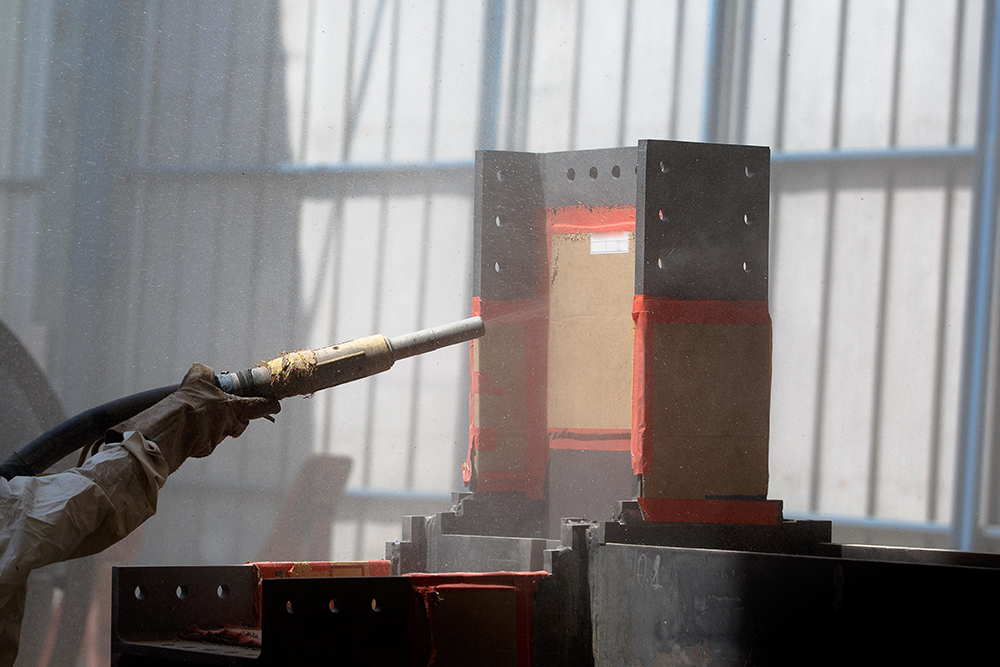
Surface preparation by sandblasting

Sandblasting and its amazing benefits deserve to be in the spotlight this September.  Why, you ask? Because in the blink of an eye, the sandblasting department at Double R Manufacturing can give new life to an old piece of equipment or masterfully create a design of your dreams.

Through skillful sandblasting and meticulous workmanship, Double R’s artisans can transform a rusty piece of metal into a shiny new piece of art.  To help everyone understand the sandblasting process and its benefits, here are a few answers to customer questions.

Sandblasting Questions – Asked and Answered

– What is sandblasting?  During sandblasting (a/k/a abrasive blasting), tough surfaces are powerfully cleaned, crafted, or smoothed with a high-speed stream of air and solid particles. Double R’s professionals propel the stream toward a piece to create a desired effect.

– How does it work? First, air and solid particles (i.e., sand, grains, granulated bits) are mixed in the chamber of Double R’s high-quality sandblasting equipment.  Then our skilled artisans point the sandblasting equipment’s nozzle toward the surface of the piece (a sturdy material, such as steel) and forcibly blast that abrasive mixture to clean, craft, or smooth the piece.

– When is sandblasting done? Sandblasting has diverse purposes and is used in many industries.  In addition to cleaning off dirt, rust, corrosion, and contaminates – sandblasting also smooths a rough surface to improve the successfulness of sealants, coatings, or other applications.  Double R’s sandblasting experts can also use this technique to forcibly shape a surface or etch designs.

– Why choose sandblasting? This surface treatment process is suitable for cleaning and giving new life to old pieces or creating an array of new materials and types of equipment. At Double R Manufacturing, we also emphasize the benefits of sandblasting materials for surface coating preparation (such as final powder coating). Double R’s sandblasting techniques help ensure superior surface quality, corrosion prevention, and longevity.

– What can we sandblast?  You name the piece of metal, and Double R Manufacturing’s skilled engineers and craftsmen have the tools and solutions for you. Our sandblasting skills have helped us create a huge selection of entrance gates, barn and stall equipment, accessories, railings, stairs, custom steel wall art, carts, trailers, tool boxes, party grills, shelving, ramps, storage boxes, bars, serving tables, signage, marine products, and more.

Whether we work with an individual or corporation, one piece or thousands, Double R’s sandblasting department loves a challenge.

Call Double R Manufacturing today at (800) 813-3361 to learn more about our products and services.  We are ready to meet your needs and surpass your expectations.