Vintage Tractor Restoration

There’s something deeply satisfying about a vintage tractor running the way it did fifty years ago. Or a classic piece of farm equipment—a hay baler, a grain elevator, an old pull-behind plow—restored to working condition rather than left to rust in a fence row. For a lot of people, this isn’t just about nostalgia. It’s about preserving equipment that was built to last, honoring the craftsmanship of an earlier era, and in many cases, putting something genuinely useful back into service.

But restoration is not a simple process. Old iron comes with old problems: corrosion that runs deeper than it looks, parts that haven’t been manufactured in decades, metal fatigue that isn’t visible to the naked eye, and surface damage that tells the story of every hard season the machine endured. Bringing that equipment back properly requires more than a wire brush and a coat of paint. It requires a fabrication shop with the right combination of skills, equipment, and patience to work through the challenges that vintage restoration almost always presents.

At Double R Manufacturing and Double R Machining, restoration work draws on nearly every service we offer—often within a single project. Here’s a look at what that actually involves.


The Assessment: Starting With What You Have

Every restoration begins the same way: understanding the true condition of the piece. Surface rust is one thing. But decades-old farm equipment has often experienced stress fractures in welds, thinning metal from corrosion-from-the-inside-out, bent or twisted structural members, and fasteners that are essentially fused in place.

Before any work begins, it’s worth doing a thorough mechanical and structural assessment. What’s solid? What’s compromised? What’s missing entirely? The answers to those questions shape everything that follows—the order of operations, which services are needed, and whether certain components need to be fabricated from scratch because they simply can’t be sourced anywhere else.

That last point comes up more than people expect. Parts for equipment manufactured in the 1940s, 1950s, and 1960s often don’t exist in the aftermarket anymore. Reproduction parts for common vintage tractors are available, but anything more specialized—a custom bracket, a wear plate, a specialized linkage component—may need to be fabricated to original specifications or reverse-engineered from what’s left of the worn-out original. This is where CNC machining and custom fabrication become central to the restoration process, not just finishing touches.


Sandblasting: Getting Down to the Truth

Before any welding, fabrication, or finishing can happen, the metal needs to be clean—genuinely clean, not just surface-clean. This is where sandblasting earns its place as one of the most important steps in any serious restoration.

Decades of paint, rust, grease, and surface oxidation can hide the actual condition of the metal underneath. Sandblasting strips all of it away, revealing hairline cracks, pitted surfaces, thinned sections, and areas where rust has eaten further than expected. On vintage equipment, this step regularly changes the scope of the project—in ways that ultimately save money and produce a better result.

Sandblasting also creates the surface profile that makes subsequent finishing work last. Paint, primer, and powder coating all bond more effectively to a properly blasted surface than to metal that’s been sanded or chemically stripped. For a restoration that’s meant to last another fifty years rather than just look good for a season, that bond quality matters enormously.

Different media are used for different situations. Aggressive abrasives remove heavy rust and scale quickly. Finer media are used for thinner metal or surfaces where maintaining dimensional accuracy is important. The right choice depends on the material, its condition, and what comes next in the process.


Welding: The Heart of Structural Restoration

For vintage equipment with any structural damage, welding is where the real restoration work happens. Cracked frames, broken mounting tabs, worn attachment points, split seams on implements—these are the kinds of repairs that determine whether a piece of equipment is genuinely restored or just cosmetically refreshed.

Quality welding on restoration projects requires more than technical skill. It requires understanding how the original piece was constructed, what stresses it was designed to handle, and how decades of use may have changed the properties of the surrounding metal. Welding into old, potentially brittle, or work-hardened metal demands careful preparation and the right process selection. A weld that looks good but doesn’t account for the condition of the base metal can fail under load—often at the worst possible moment.

For structural repairs on frames and load-bearing components, the goal is always a repair that’s as strong as or stronger than the original construction. For cosmetic or non-structural repairs—restoring sheet metal, replacing worn panels, fabricating missing trim or guards—the goal shifts toward matching original appearance while maintaining durability.

Custom fabrication steps in when original parts can’t be welded back together or sourced elsewhere. A mounting bracket that’s cracked beyond repair gets reverse-engineered and fabricated new. A worn wear plate gets replaced with a fresh piece cut to the original profile. A missing implement hitch gets built to spec. These aren’t workarounds—they’re how a proper restoration handles the realities of working with old equipment.


CNC Machining: Precision Where It Counts

Not every restoration need involves structural steel. Vintage tractors and farm equipment have shafts, bushings, gears, pins, and precision-fit components that may be worn, damaged, or completely unavailable as replacement parts.

This is where CNC machining fills a critical gap. When a worn shaft needs to be turned to original dimensions, when a bushing needs to be machined to fit a specific bore, or when a simple but unobtainable part needs to be replicated from a drawing or a physical sample, precision machining makes it possible. The alternative—hunting for a reproduction part that may or may not exist, or running worn components that introduce slop and accelerate further wear—rarely produces a better outcome.

For collectors and restorers working on equipment that still needs to function rather than just display, machined components often make the difference between a tractor that runs right and one that runs well enough.


Powder Coating: A Finish Built to Last

Once the structural work is done and the surfaces are prepared, the finishing stage determines how the restoration holds up over time. For vintage farm equipment that’s going back into service, or even for display pieces that will be exposed to the elements, powder coating is the most durable finish available.

Unlike liquid paint, powder coating is applied electrostatically and cured under heat, producing a finish that bonds at a molecular level with the metal surface. It’s significantly more resistant to chipping, scratching, UV fading, and moisture than conventional paint—and when applied over a properly sandblasted surface, it can realistically last decades without significant deterioration.

For restoration work, powder coating also offers something liquid paint traditionally struggles with: consistency. Color matching to original equipment colors is achievable, and the finish quality is uniform across complex shapes and hard-to-reach surfaces in ways that brush or spray application can’t always replicate.

For pieces where absolute originality is the goal—concours-level restorations for show or competition—some restorers prefer period-correct liquid paint finishes. That’s a legitimate choice. But for equipment that’s going back to work, powder coating’s durability advantage is hard to argue with.


The One-Stop Advantage in Restoration Work

What makes complex restoration projects challenging isn’t usually any single service—it’s the coordination between them. Sandblasting before welding. Welding before machining. Machining before final assembly. Powder coating last. When those steps happen in different places, with different shops, communication gaps, scheduling conflicts, and inconsistent standards add up quickly.

Handling the full sequence under one roof changes that dynamic. Assessment, sandblasting, welding, fabrication, machining, and powder coating as a coordinated workflow means each step is done with knowledge of what comes before and after. It also means that when the assessment reveals something unexpected—and in vintage restoration, it almost always does—the response can be immediate rather than involving multiple vendors and rescheduling chains.


Old Iron Deserves the Right Shop

Vintage and classic equipment restoration is patient, skilled work. The machines themselves were often built by craftsmen who took pride in their work, and bringing them back properly honors that original craftsmanship. It also, in many cases, produces a result that’s more durable and more capable than anything available as a modern replacement.

If you have a vintage tractor, a piece of classic farm equipment, or old iron of any kind that deserves better than the fence row it’s been sitting in, Double R Manufacturing is ready to put it back where it belongs.

Double R Manufacturing is celebrating National Decorating Month. If you want to double the benefits of decorating homes or updating businesses, consider adding custom-built pieces.

Forget the flimsy furniture, lack-luster signage, and faulty equipment. Double R’s experts are explaining two of the best ways to invest in both quality and style when selecting new items for your homes, ranches, farms, or businesses.

Customized Products, Equipment, and Decorative Pieces

American businessowners, ranchers, farmers, and residential homeowners deserve a return on their investments when buying customized products and equipment. Whether for decorative pieces or for essential business purposes, consider these decorating ideas:

  1. In terms of value for furniture and necessities, custom-built tables, bars, benches, and other pieces can add a level of style and sophistication. Double R’s customized products are built to outlast any rickety or out-of-the-box items. When decorating a home or business, your customized furniture will fit perfectly in a space to make the right impression. Just ask Double R’s skilled artisans and engineers about how we can help ensure the proper fitting and aesthetics for your setting.
  2. For personalized décor or business branding, wall art and custom signage are a must. Artfully, Double R’s design team can create customized wall art and signage with special patterns, images, names, monograms, or logos. We can incorporate a wide array of materials like custom stone, glass, wood, and metal. Consider decorating with glass cases to display special items, custom works of wall art and yard art, or professional interior and exterior signs for your business.

In addition to color customizations and decorative styles for furniture and signage, Double R provides many other types of manufacturing services. We design and manufacture gates, fencing, railings, stairs, barn equipment, trailers, truck conversions, custom BBQs, carts bumpers, small bridges, ramps, toolboxes, roof supports, shelving, clothing racks, storage boxes, hooks, marine products, and more to enhance your residential or commercial properties.

Manufacturing Items for Homes and Office Settings

We can weld, sandblast, waterjet cut, and transform steel, metal, wood, and other materials to create décor for your homes or office settings. Whether working with a homeowner during a remodel, or helping businessowners spotlight their corporate branding, Double R’s creative experts will surpass your expectations when manufacturing items.

Call Double R Manufacturing today at (800) 813-3361 to discuss customized furniture, products, and equipment to fit your budget, décor, style, and project goals.
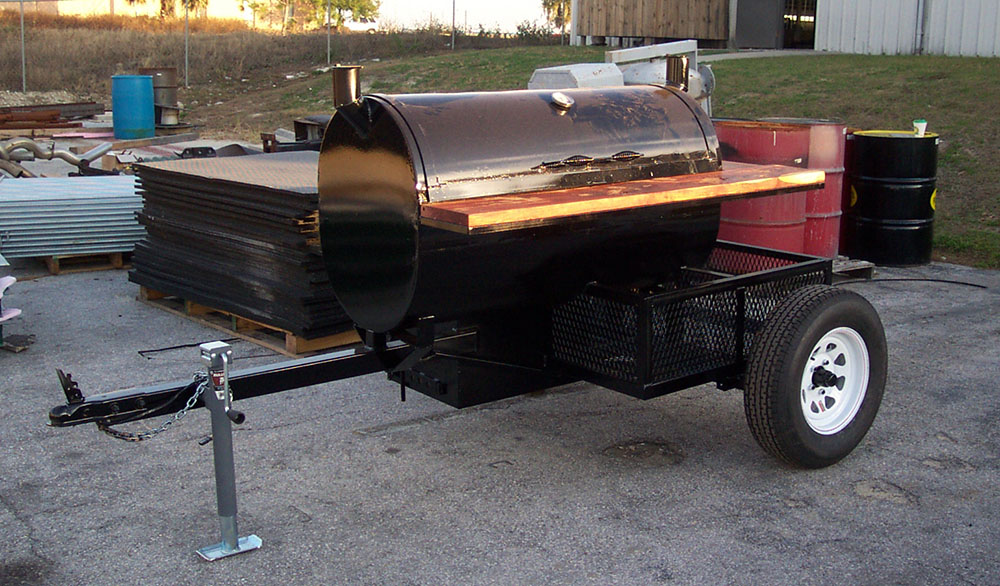
Fall sports fans are cheering at tailgating parties and outdoor events. Our team at Double R Manufacturing wants to help you enjoy the season and celebrate National Tailgating Month this September with custom-built trailers, barbeques, grills, smokers, and stylized carts.

Whether you are a football fan attending your local team’s tailgating party, or you are a barbeque food vendor traveling to fall festivals across the U.S., Double R can help stylize and optimize your trailers, carts, and trucks for fantastic food and fun.

Custom Grills, BBQs, and Smokers for Fall Events

Barbecuing and grilling before a big game are American traditions. Local, high school, college, and national leagues all host great tailgating parties and fall events in parking lots and outside stadiums nearly every weekend throughout autumn.

Fittingly, Double R’s team is putting a special focus on fabricating trailers, BBQs, smokers, grills, and carts this fall. From the sturdy metals to the welding and assembling, customers are always impressed by the level of detail and quality of each custom-built item.  Stylizations also include countless color options for the final powder coating, meaning your team’s colors can always be fully displayed at your tailgating party.

As for businesses and commercial vendors, they also love adding customized features like logos and promotional signage to trucks, trailers, carts, grills, and smokers.  Best of all, vendors trust that a Double R-designed piece will last the long haul. These are not rickety or generic items. Double R customizes items to last throughout all seasons and long-distance travels.

As always, customers are welcome to supply logos or describe their creative ideas to launch the custom-design process. View a few examples of past designs delivered to valued customers across the U.S.: Custom Barbeque Grills.

Manufacturing Services for Trailers and Truck Conversions

At Double R Manufacturing, we understand that reliability and durability is essential not only during the tailgating party, but also after the party is over. Customers choose Double R for fabrication as well as full maintenance for carts and brand-name trailers, including lighting, axles, and bearings.

Remember, however, Double R is not just a one-trick pony for your tailgating party. Beyond the barbeque carts and trailers, we are among an elite industry of experts in trailer repairs, truck conversions, and full fabrication for commercial, utility, cargo, boat, camper, and other specialty equipment. View our gallery of trailers and truck conversions at: Truck Conversations.

Double R Manufacturing wishes you a happy tailgating season. Contact us to help kick off your fall events with high-quality products and equipment. Call us today at (800) 813-3361.